
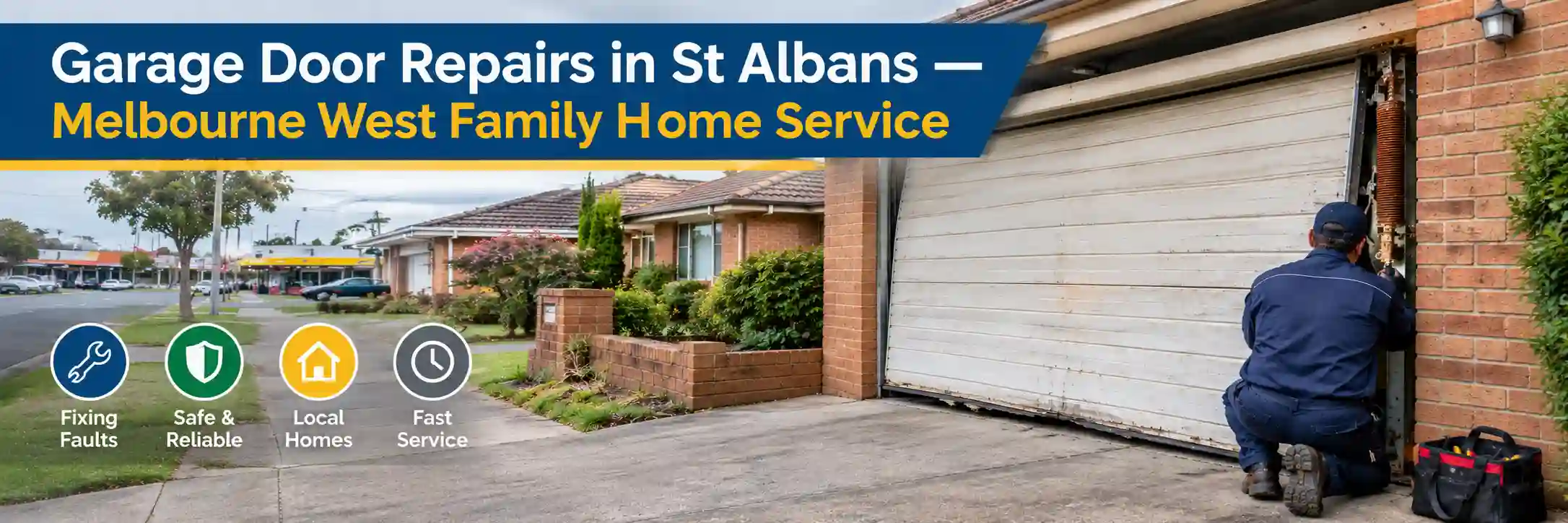
Garage door repairs in St Albans serve one of Melbourne’s most culturally diverse and most rapidly evolving western suburbs. St Albans sits 16 kilometres north-west of the Melbourne CBD in the City of Brimbank — a suburb that began as a settlement of owner-built timber homes in the post-war period and has transformed, through the 1960s brick veneer estate developments and the multicultural community growth of the past four decades, into one of western Melbourne’s most vibrant residential areas.
With a population of over 38,000 and more than half of its residents born overseas — representing Vietnamese, Chinese, Italian, Indian, and many other cultural communities — St Albans is a suburb where the standard of trade service provided to homes is as important to the household as in any inner Melbourne suburb, and where the specific conditions of the 1960s and 1970s brick veneer housing that dominates the residential streets create a specific garage door repair profile.
St Albans housing stock and garage door profile
The residential streets of St Albans are dominated by brick veneer homes from the 1960s and 1970s — the estates that replaced the earlier owner-built timber homes and makeshift dwellings of the suburb’s post-war settler period with the standardised suburban development that characterised Melbourne’s outer western growth during these decades. These brick veneer homes are now 50 to 60 years old, and their garage door systems reflect this accumulated age.
The standard garage configuration in St Albans’ established brick veneer homes is a single-car garage integrated into the front of the dwelling or as a side-return structure, with an original or early-replacement tilt door or — for homes that were updated in the 1990s — a roller door from that period.
The more recent development activity in St Albans — the Residential Growth Zone that covers 9.14% of the suburb, the subdivision and multi-dwelling developments visible in the Brimbank City Council DA records, and the higher-density developments near the St Albans station and along the main arterial routes — has added contemporary roller and sectional door installations to the suburb’s garage door repair landscape alongside the much older established stock.
The 1960s brick veneer repair profile in St Albans
Garage door repairs in St Albans for the suburb’s dominant 1960s housing stock reflect the specific failure modes of 50 to 60 year old garage door systems in Melbourne’s western climate:
- Original tilt door spring failures — the tilt doors in St Albans’ 1960s brick veneer homes have counterbalance springs that in many cases have never been replaced since the home was built. Springs that are 50 years old and have been through 50 Melbourne winters in an uninsulated brick veneer garage have accumulated both mechanical fatigue and the winter condensation corrosion that Melbourne’s cold, damp winters deliver to unlubricated spring steel. Spring failure in these older systems is the most common garage door emergency call in St Albans.
- Early roller door motor failures — homes in St Albans that had their original tilt doors replaced with roller doors in the 1990s now have roller door motors that are 25 to 30 years old — ageing chain-driven AC openers whose drive gears, circuit boards, and motor windings have degraded through decades of Melbourne’s seasonal cycling.
- Panel and curtain deterioration — steel panels and roller curtains in St Albans’ western Melbourne environment have been through the full range of Melbourne’s weather: cold wet winters, hot summers with occasional extreme heat days, and the wind-driven rain events that Melbourne’s exposure to the western plains produces. Steel surfaces on garage doors that have never been repainted or treated have developed surface rust at panel edges, fixing points, and at the lower curtain sections closest to the ground.
- Guide rail misalignment from brick veneer movement — brick veneer homes in St Albans, like brick veneer homes throughout Melbourne’s western suburbs, sit on reactive soils that move seasonally. Seasonal soil movement can change the dimensions of the garage opening, causing guide rails to shift out of alignment and doors to bind or travel unevenly. A garage door that has begun to grind or resist at a specific point in its travel cycle may be responding to guide rail misalignment from reactive soil movement rather than a mechanism fault.
City of Brimbank planning for garage door repairs
Garage door repairs in St Albans under the City of Brimbank’s planning framework follow Victoria’s planning system. Standard mechanical repairs do not require a planning permit under the Brimbank Planning Scheme. St Albans does not have the Heritage Overlay complexity that Preston’s Darebin Heritage Study creates — the General Residential Zone that covers 55.4% of St Albans and the Neighbourhood Residential Zone and Residential Growth Zone that cover the remainder have no heritage precinct designations that would trigger Heritage Overlay permit requirements for standard garage door repairs or replacements. This means St Albans homeowners can proceed with standard garage door repair and replacement decisions without the heritage planning consultation that is essential for Preston’s Heritage Overlay precincts.
The multicultural community dimension of St Albans repairs
Garage door repairs in St Albans serve a community whose cultural diversity — with more than half of residents born overseas — creates a range of household configurations and communication expectations. Long-tenure Vietnamese, Italian, and Chinese families who have owned their brick veneer homes for decades are managing garage door systems that may have had limited professional maintenance during their tenure. Newer arrivals from India, Southeast Asia, and other communities who have purchased St Albans properties as their first Melbourne home are encountering garage door maintenance as a new element of Australian home ownership. A technician who communicates clearly in English, provides written quotes before commencing, and explains what the repair involves and why it is needed serves the full range of St Albans’ diverse community effectively.
Reactive soils and Melbourne west garage door challenges
Garage door repairs in St Albans have the reactive clay soil dimension that also affects Auburn in NSW and parts of Brisbane’s outer suburbs. Melbourne’s western suburbs are predominantly underlain by the Coode Island Silt and similar reactive clay formations that expand when wet and contract in dry conditions. The seasonal soil movement cycle — expanding in Melbourne’s wet winters and contracting in its dry summers — creates the foundation movement that changes the dimensions of garage openings in brick veneer homes, misaligns guide rails, and creates binding and travel faults that recur with the seasons if the underlying soil movement cause is not identified. A western Melbourne-experienced technician who understands reactive soil movement recognises this cause when the presenting symptom is a door that grinds at the same point every dry season.
St Albans’ commercial precincts — the St Albans town centre along Main Road and St Albans Road, the Asian grocery stores and Vietnamese restaurants that reflect the suburb’s significant Southeast Asian community, the multicultural markets and the St Albans Connect urban renewal initiatives that Brimbank City Council has invested in — reflect a suburb that is genuinely thriving and evolving rather than simply ageing in place.
The homeowners who call for garage door repairs in St Albans are part of this evolving community — families who have built their lives in the suburb over decades and who are now maintaining properties that carry the accumulated service needs of those decades, alongside newer arrivals who are investing in properties as their entry into Melbourne’s western housing market. A technician who treats each St Albans household with respect for the investment they have made in their property — who explains clearly what the repair involves, why the component has failed, and what preventive maintenance would reduce the risk of recurrence — is one who serves this community at the standard it deserves.
The City of Brimbank’s Victoria Planning Scheme provides the regulatory context for all building works in St Albans, including garage door repairs and replacements. Unlike the Heritage Overlay provisions that create planning permit requirements in Preston’s Darebin Planning Scheme, the Brimbank Planning Scheme’s residential zones for most of St Albans do not carry heritage designation that triggers Heritage Overlay assessment. This means that the planning dimension of garage door repair in St Albans is generally straightforward — standard repairs proceed as maintenance without planning assessment, and standard replacements are typically exempt from permit requirements in the General Residential Zone that covers the majority of the suburb.
The absence of Heritage Overlay complexity in most of St Albans is one of the practical differences between this western Melbourne suburb and Preston’s inner north heritage precincts that shapes the repair and replacement process for St Albans homeowners.
Conclusion
Garage door repairs in St Albans serve one of Melbourne’s most multicultural and most rapidly growing western suburbs — a community whose 1960s brick veneer housing stock carries 50 to 60-year-old garage door systems through Melbourne’s demanding four-season climate, whose reactive clay soils create guide rail misalignment that recurs seasonally, and whose diverse household community expects clear communication, written pricing, and professional workmanship from every trade service engagement.
A City of Brimbank-based technician who understands the western Melbourne housing stock, the reactive soil dimension, and the communication expectations of St Albans’ multicultural community serves this suburb correctly.