
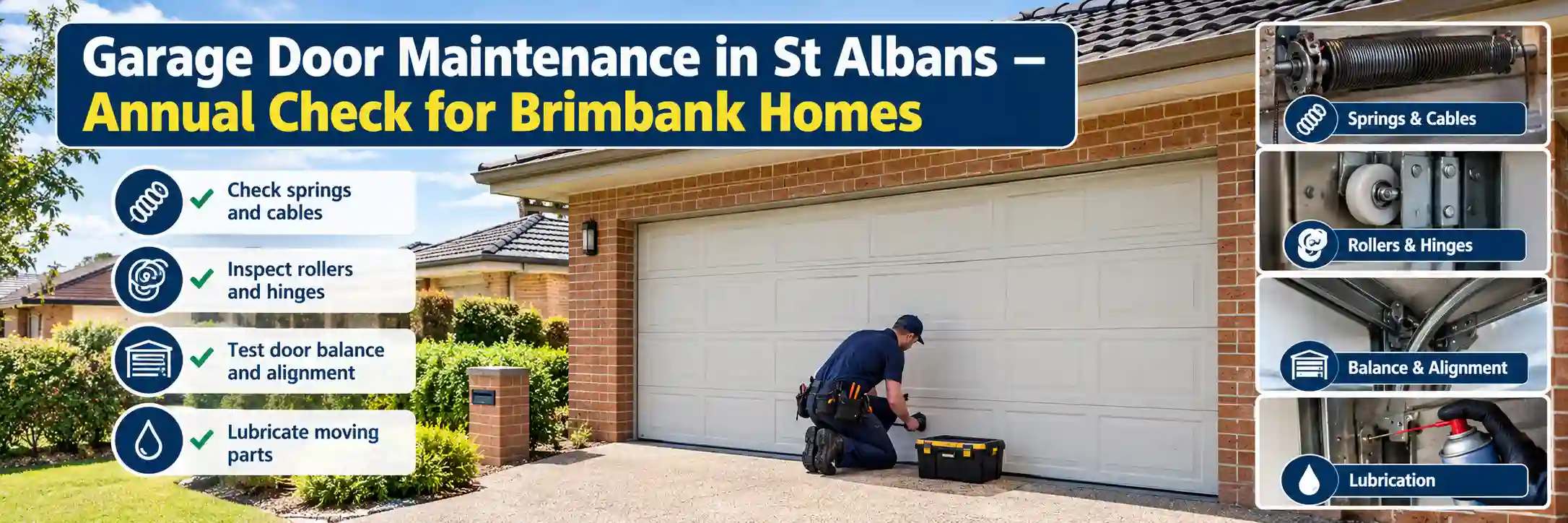
Garage door maintenance in St Albans is the annual investment that protects the garage door systems in a suburb whose 1960s and 1970s brick veneer housing stock carries Melbourne’s most age-stressed residential garage door mechanisms. St Albans’ homes were built at a period when garage door specifications, installation standards, and maintenance expectations were at their most basic — the garage door was a functional necessity rather than a maintained component of the home.
Fifty to sixty years later, those original or early-replacement systems carry the accumulated service deficit of decades of Melbourne winters without professional maintenance — springs that have been through 40 winter condensation cycles without lubrication, cables whose end fittings have been corroding internally for years, and guide rails that have been accumulating reactive clay soil movement alignment changes with each Melbourne dry season. Garage door maintenance in St Albans for this generation of homes is as much a remediation programme as it is a routine service.
Melbourne’s western suburban climate and St Albans garage door maintenance
Garage door maintenance in St Albans addresses a climate that is specific to Melbourne’s western exposure — the coldest and wettest sector of Melbourne’s metropolitan area in winter, and one of the more heat-exposed in summer. St Albans’ distance from Port Phillip Bay means the suburb lacks the coastal moderation that Melbourne’s bayside suburbs enjoy in summer, and its western position means it is first in line for the cold, wet south-westerly systems that bring Melbourne’s most persistent winter weather. The climate effects on garage door components:
- Winter moisture and spring corrosion — as the spring replacement blog describes, Melbourne’s winter condensation is the primary corrosion driver for spring wire in unheated St Albans garages. The annual maintenance lubricant application — using a product with moisture-displacing and corrosion-inhibiting properties — is the most important single maintenance action for preventing the premature spring failure that Melbourne’s winter moisture produces on unprotected springs.
- Wind-driven rain and seal failure — Melbourne’s westerly and south-westerly winds drive rain horizontally across the western plains, forcing rain under door seals and through side weatherstripping gaps that would resist vertically falling rain. A bottom seal that is cracked or hardened from Melbourne’s UV and temperature cycling allows wind-driven rain to enter the garage during every westerly rain event. The maintenance visit should specifically test the seal’s integrity against the horizontal rain entry that western Melbourne’s weather produces.
- Summer heat and motor performance — Melbourne’s occasional extreme heat days — the north-westerly air mass events that push temperatures above 40 degrees Celsius across the western suburbs — create the motor thermal protection dimension that the western Melbourne garage door share with Perth’s Canning Vale and Sydney’s Penrith. The motor thermal protection check at the spring maintenance visit confirms the motor is operating within its thermal limit on the hottest days.
Reactive clay soil and the guide rail alignment check
Garage door maintenance in St Albans for brick veneer homes on reactive clay soils has a specific structural dimension that is not part of the standard maintenance checklist in more stable geological environments. The guide rail alignment check — confirming that both rails are plumb, parallel, and correctly spaced for the door’s roller wheels — should be conducted at every maintenance visit for St Albans homes with a history of reactive soil movement. The signs that guide rail misalignment from reactive soil movement is present:
- A door that grinds or binds at the same specific point in its travel cycle, but operates smoothly at other points.
- A door whose binding severity changes with the season — worse in dry conditions when the soil has contracted and better after winter rain when the soil has re-expanded.
- A door whose roller wheel shows uneven wear — more wear on one side of the wheel’s running surface than the other — indicating that the rail is not running parallel to the door’s true vertical.
Realigning guide rails that have moved from reactive soil movement is a maintenance intervention that goes beyond the standard lubricant and inspection routine, but it is the intervention that prevents the continued deterioration of roller wheels, cables, and motor loads that a persistently misaligned guide rail causes.
The St Albans maintenance calendar
Garage door maintenance in St Albans follows Melbourne’s seasonal pattern:
April-May — pre-winter service: Apply corrosion-inhibiting lubricant to springs, cable drums, guide rails, and all metal components before Melbourne’s winter begins. Replace any bottom seal or side weatherstripping that has cracked or hardened from summer UV. Test the motor’s operation and safety reversal function. For St Albans homes on reactive clay where the soil has been dry through summer and will expand with winter rain, confirm the guide rail alignment before winter and note the baseline for comparison after winter.
October — post-winter inspection: Inspect springs for any surface rust that developed through winter condensation cycling. Check cable end fittings with a torch for internal corrosion staining. Confirm guide rail alignment after winter soil expansion. Apply fresh lubricant before summer. Test the motor’s thermal protection function before summer heat arrives.
The full St Albans maintenance checklist
Garage door maintenance in St Albans covers all components with western Melbourne-specific attention:
- Spring inspection — inspect all spring coils for surface rust with a torch. For St Albans’ older tilt door extension springs, inspect the spring coils along their full length and the hook-and-eye connection points where corrosion concentrates. Apply corrosion-inhibiting lubricant to the full spring length.
- Cable condition and end fitting inspection — inspect cables from end fitting to drum. Check both end fittings with a torch for internal corrosion staining. In Melbourne’s western suburbs where soil moisture varies seasonally, cable end fitting corrosion is a consistent finding in homes with older systems.
- Guide rail cleaning and alignment — clean guide rail channels of accumulated dust, debris, and degraded lubricant. Check rail plumb and parallelism. Lubricate running surfaces with a product appropriate for Melbourne’s temperature range.
- Roller wheel condition — inspect each roller for flat spots, worn bearings, or cracking from Melbourne’s UV. Replace worn rollers.
- Seal and weatherstripping inspection — test the bottom seal and side weatherstripping against horizontal rain entry. Replace any seal that fails to contact the floor or frame surface continuously along its full length.
- Motor service — test all functions, confirm limit switch calibration, check drive chain or belt tension, test safety reversal function with a timber block under the door.
St Albans’ community investment in the suburb’s renewal — the St Albans Connect programme, the Activity Area Structure Plan 2025, and the physical improvements that Brimbank City Council has made to the suburb’s public realm and commercial precincts — reflects a community that is investing in its future rather than accepting its past condition as permanent. Homeowners who participate in this community renewal by maintaining their properties — painting their facades, updating their gardens, maintaining their garage doors — are contributing to the collective improvement of St Albans’ residential streetscapes that the renewal investment is designed to catalyse.
Garage door maintenance is one element of this collective property investment, and the homeowner who commits to an annual maintenance programme for their garage door is making the same quality investment that the community renewal initiatives make at the public level — consistent, annual, forward-looking, and cumulative in its benefit to the suburb’s overall presentation and desirability.
The maintenance culture in St Albans is evolving alongside the suburb’s community evolution. The original owner-builders who constructed their own homes in the 1950s and 1960s had a hands-on maintenance relationship with their properties — they maintained what they had built, understood the physical fabric of their homes, and knew when components needed attention. Successive generations have sometimes had less connection to the physical maintenance of the properties they have inherited or purchased.
The garage door technician who visits a St Albans home for the first annual maintenance visit and explains the maintenance programme to an owner who has never considered the garage door system as something that needs annual professional attention is one who is transferring the practical knowledge that was once embedded in the owner-builder culture of the suburb’s earliest residents. This knowledge transfer — patient, clear, and practical — is the maintenance technician’s most valuable contribution to the long-term performance of the St Albans housing stock.
Conclusion
Garage door maintenance in St Albans is the annual investment that extends the service life of the suburb’s ageing 1960s brick veneer garage door systems through Melbourne’s demanding four-season western climate. Corrosion-inhibiting lubricant applied before winter, guide rail alignment checked for reactive soil movement, bottom seal replaced before the wind-driven rain season, motor thermal protection tested before summer — these are the specific maintenance actions that address St Albans’ specific conditions.
The April-May pre-winter service and the October post-winter inspection, conducted annually by a western Melbourne technician who understands Melbourne’s clay soils and westerly weather, are the visits that prevent the emergency spring failure call in the middle of July and the garage door that fails to close on a Melbourne autumn evening with rain driving from the south-west.