
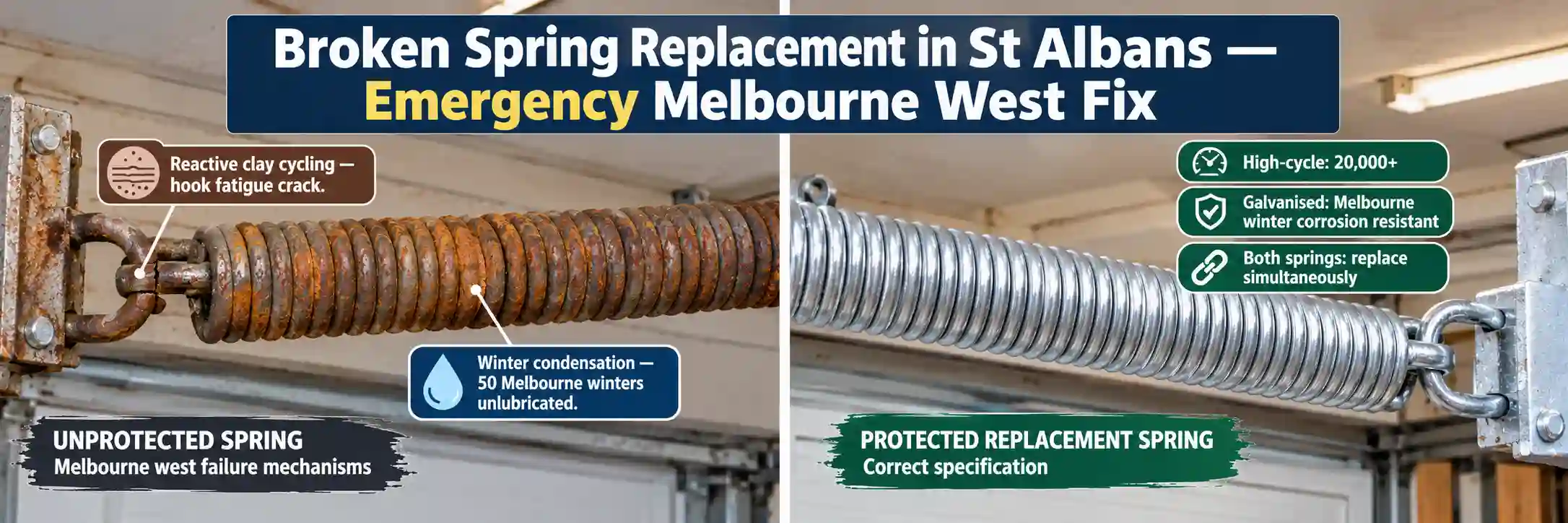
A broken garage door spring in St Albans is the emergency that stops the door and the household’s daily routine without warning. In a suburb where the dominant housing stock is 1960s and 1970s brick veneer with garage door systems that are 40 to 60 years old, and where Melbourne’s cold wet winters create the condensation and moisture conditions that accelerate spring corrosion on unlubricated steel, the broken spring is not simply bad luck but the predictable outcome of decades of Melbourne seasons acting on spring wire that has been in service without professional maintenance since it was installed. Broken spring replacement in St Albans addresses why springs fail in Melbourne’s western suburbs, what the immediate steps are when a spring fails, and what the correct replacement specification involves for western Melbourne’s specific climate conditions.
Why springs fail in St Albans’ 1960s homes
Spring failure in St Albans occurs through two mechanisms that Melbourne’s western suburban environment specifically promotes:
Mechanical cycle fatigue — a spring has a designed cycle life — a number of operating cycles (each opening and each closing counts as one cycle) after which the metal wire has accumulated enough fatigue to reach the failure threshold. A standard residential torsion spring rated for 10,000 cycles in a household that operates the door four times per day reaches its cycle limit in approximately 7 years. But St Albans’ 1960s homes with original springs may have springs that were installed in 1965, 1970, or 1975 — springs that are 50 to 60 years old and that have been through vastly more than 10,000 cycles in service. In most cases, these springs have already exceeded their designed life several times over and have been operating on borrowed time for years before the failure occurs.
Melbourne winter condensation corrosion — Melbourne’s cold, wet winters create condensation on the metal surfaces of garage door springs inside unheated garages. The temperature differential between the cold spring metal and the relatively humid winter air creates a moisture film on the spring wire surface that drives the electrochemical corrosion reaction. Over multiple Melbourne winters, this condensation corrosion weakens the spring wire cross-section by producing surface pitting and rust that reduces the wire’s effective diameter and therefore its yield strength at the most corroded points. A spring that has been through 20 or 30 Melbourne winters without a corrosion-inhibiting lubricant has accumulated significant cross-section reduction at its most moisture-exposed sections, creating the stress concentration points where the fatigue crack initiates and the eventual failure fracture propagates.
The reactive soil connection to spring failure in St Albans
Broken spring replacement in St Albans has a specific dimension that is unique to western Melbourne’s reactive clay soil environment. Reactive clay soils expand when wet and contract when dry, and the seasonal movement of the soil beneath a St Albans brick veneer home can change the relationship between the door panel and the spring system. A door that sits at a slightly different height when the soil is dry than when it is wet is a door whose spring system is being loaded differently across the seasonal cycle — slightly overtensioned when the door is in one soil-movement position and slightly undertensioned in the other.
This cyclic over-and-under-tension loading accelerates the fatigue mechanism in the spring, bringing the failure threshold closer than it would arrive in a stable installation on non-reactive soils. For St Albans homes on the most reactive clay formations, spring service life may be shorter than the manufacturer’s cycle rating predicts.
The immediate steps for a St Albans broken spring
Stop all door operation immediately. If the door has an automatic opener, pull the red emergency release cord to disconnect the opener from the door.
Do not attempt to manually lift the door. A garage door whose spring has failed has lost its counterbalancing mechanism — the door’s full weight is unassisted, and attempting to lift it without the spring’s counterbalance is both physically unsafe and risks further damaging the door panels, cables, and the opener mechanism.
Assess the door’s position. A door stuck in the open position is a security issue — call for same-day service. A door stuck in the closed position that has a vehicle inside may require same-day service if the vehicle is needed urgently.
Call a Melbourne western suburb garage door technician for same-day service. Confirm that the technician carries the spring specifications appropriate for the St Albans housing stock — both tilt door extension springs for the older 1960s homes and torsion springs for roller and sectional door systems.
While waiting, confirm that no family members attempt to operate the door or interact with the spring mechanism. A failed spring under tension retains stored energy that releases when the spring is disturbed, creating a safety hazard for anyone in the garage opening or near the spring hardware.
Specifying replacement springs for St Albans homes
Broken spring replacement in St Albans should use a specification appropriate for Melbourne’s western suburban environment:
- High-cycle springs — for St Albans homes where the spring is being replaced after decades of service, installing a high-cycle replacement spring — rated for 20,000 or 30,000 cycles rather than the standard 10,000 cycles — provides significantly extended service life between replacements. A household that cycles the door four times daily reaches 10,000 cycles in approximately 7 years but reaches 20,000 cycles in approximately 14 years, and 30,000 cycles in approximately 20 years. The high-cycle spring is the investment that prevents the next spring replacement from occurring at the worst possible time — again without warning, during a Melbourne winter.
- Corrosion-resistant coating — a galvanised or powder-coated spring provides corrosion protection against Melbourne’s winter condensation mechanism. A coated spring maintains its wire cross-section integrity through multiple Melbourne winters by preventing the electrochemical corrosion that bare steel accumulates. This coating protection is the specific investment that addresses the corrosion fatigue mechanism that is the primary life-shortening factor for springs in Melbourne’s western suburbs.
- Both springs replaced simultaneously — in a two-spring system (common for tilt door configurations), both springs should be replaced in the same visit. The second spring has the same age and the same corrosion history as the failed spring, and will likely fail within months of the first spring’s replacement if it is left in service.
- Correct tension calibration for reactive soil context — the replacement spring should be tensioned to match the door’s weight at its typical operating height, with a balance test that confirms the door holds stationary at the midpoint of its travel when released. For St Albans homes on reactive clay where seasonal soil movement changes the door’s effective hang, a balance test conducted in the mid-season should be rechecked after the following season’s significant movement.
Post-replacement maintenance for St Albans springs
Broken spring replacement in St Albans followed by the annual maintenance programme that the maintenance blog describes — lubricating with a corrosion-inhibiting product, inspecting the cable end fittings for internal corrosion, and confirming the guide rail alignment has not been affected by reactive soil movement — is the combination that extends the replacement spring’s service life to its full rated cycle count.
The spring that is correctly specified, correctly installed, and annually maintained in Melbourne’s western suburbs is the spring that reaches 20,000 cycles before requiring replacement rather than the spring that fails at 7,000 cycles because condensation corrosion has reduced its effective wire cross-section long before its mechanical fatigue limit.
St Albans’ multicultural community brings a specific dimension to the broken spring emergency — the household that calls for help with a failed spring may have had limited prior contact with garage door trade services, may not be aware that annual maintenance is a standard expectation for these systems in Australia, and may be encountering the spring failure as a genuinely unexpected event rather than the predictable outcome of decades of deferred maintenance.
A technician who responds to a St Albans spring failure with honesty about why the failure has occurred, what the correct replacement specification involves, and what the annual maintenance programme would look like to prevent the next failure, is one who provides a genuine service education alongside the physical repair.
This honest communication — in plain English, with the patience to explain clearly — is the specific service quality that St Albans’ diverse community most values from a trade service engagement, and it is the communication investment that turns a one-time emergency call into the ongoing service relationship that benefits both the household and the technician.
Conclusion
Broken spring replacement in St Albans is the emergency repair that is most preventable in the suburb’s 1960s brick veneer housing stock — preventable not in the sense that the eventual spring failure can be avoided forever, but in the sense that the correct spring specification (high-cycle, coated), the correct installation (both springs simultaneously, tension calibrated for the reactive soil context), and the annual maintenance programme (corrosion-inhibiting lubricant every year before Melbourne’s winter) extend the spring’s service life to its full rated cycle count in western Melbourne’s demanding four-season climate.
A broken spring that fails in St Albans is the beginning of the conversation about why it failed and how the replacement is specified to last longer than its predecessor — and that conversation, had honestly by a western Melbourne technician who understands Melbourne’s clay soils and winter condensation, is the one that prevents the next emergency call.